 Español

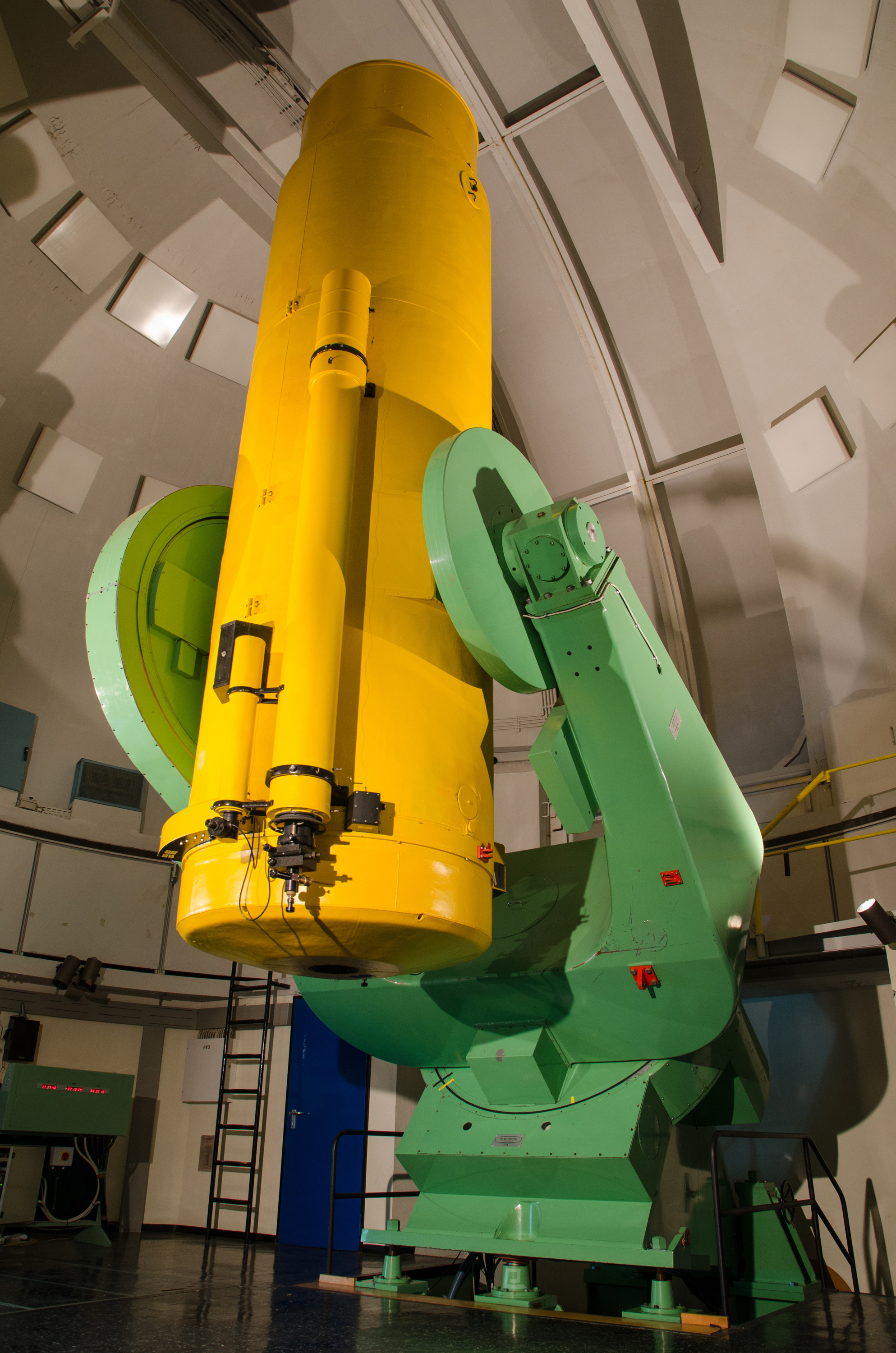
As part of a collaboration with the European Space Agency (ESA), the Schmidt telescope, located at the Centro Astronómico Hispánico en Andalucía – Calar Alto Observatory (CAHA), is equipped with a large-scale camera C5S-150 + GPS. This camera allows astronomers to observe a larger portion of the sky in a single image, thus improving the chances of detecting a missing near-Earth object. It features a novel CMOS sensor with new telescope and camera control computers.
The official list of findings with the Schmidt telescope is maintained here by the Minor Planet Center.
In a nutshell
| Instrument name | CMOS C5S-150 |
| Observing technique | Direct imaging camera |
| Sensor | CMOS Sony IMX411ALR |
| Physical size | 53.42 x 40.07 mm |
| Resolution | 14208 × 10656 pixels |
| Pixels size | 3.76 × 3.76 μm |
| Scale | 0.324”/px |
| Field of view | 76.75’ x 57.56’ |
|
|
|
| Conversion factor | 0.76 e-/ADU |
| Full well capacity | 50,000 e- at gain = 0 |
| Read-out-noise | 3.52 e- at gain = 0 |
| Shutter | Rolling Shutter (no mechanical) |
|
|
|
|
|

Space Safety Programme Near Earth Objects pillars
The Schmidt telescope at Calar Alto is set to receive a key upgrade to its detector thanks to the support of the European Space Agency (ESA) within the framework of the “Work Package 2: Observations with Opportunity Telescope”.
CMOS IMX411 sensor: This state-of-the-art Sony detector features 3.76 μm pixels, high quantum efficiency (> 85 % in the visible), and high-speed readout (> 20 fps at full resolution). It will allow very wide fields to be captured without sacrificing depth or temporal resolution.
Scientific advantages:
- Rapid imaging of large areas of the sky, ideal for Near-Earth Object (NEO) surveys and stellar variability studies.
- Very low read noise (< 2 e⁻ RMS), benefiting observations of faint objects and low-surface-brightness targets.
- Integration and control: ESA is funding both the hardware and the development of the remote-control electronics, integrating the camera into the observatory’s Python-based instrumentation. Additionally, WP2 includes automated reduction pipelines and real-time transient alert systems.
This upgrade places the Schmidt among the few historic Schmidt telescopes equipped with modern CMOS technology, extending its operational life and enhancing its discovery capabilities within ESA’s surveillance strategy.
History:
The Calar Alto Schmidt telescope has a legacy spanning more than seven decades:
Origin (1954–1980)
- Designed by Bernhard Schmidt & Otto Heckmann and installed at the Hamburg Observatory in 1954 for wide-field photographic surveys and stellar cartography.
- 24 × 24 cm photographic plates captured a 5.5° × 5.5° field at f/3 with two objective prisms for low-resolution spectroscopy.
Relocation and installation at Calar Alto (1980–1999)
- In 1980, the Max-Planck-Institut für Astronomie moved it to the Sierra de los Filabres (2 168 m).
- It was refurbished after decades of intensive use in Hamburg, adapting it for remote observing and darker skies.
Modernization and current use (2000– ...)
- In the early 2000s it fell into disuse and was retrofitted for automated operations.
- Since 2017, under contract with the ESA, it has been dedicated to near-Earth object (NEO) detection campaigns, providing critical data for planetary defense. The first cameras used were based on small CCD sensors: an SBIG ST-10XME (from 2015 to 2019) then an FLI ProLine PL230-42 (from 2020 until late 2025). Despite their limited field of view and efficiency, thousands of successful observations were performed. Erwin Schwab's website compiles some nice findings done with these CCD cameras.
The Schmidt telescope has received multiple mechanical and electronic upgrades at Calar Alto, culminating now with the WP2 project and the IMX411 sensor, which completely renews its focal system.
With this new camera, the Schmidt will continue to be a pillar of wide-field astronomy and a key instrument for asteroid and transient tracking, carrying on more than 70 years of observing history.
Technical Specifications
| Telescope name | Calar Alto Schmidt Telescope (formerly “Großer-Hamburger-Schmidtspiegel”) |
| Corrector plate material & diameter | UBK 7, Ø 0.8 m |
| Primary mirror material & diameter | ZK 7, Ø 1.2 m |
| Radius of curvature | 5 m |
| Focal length / f-ratio | 2.4 m / f/3 |
| Construction year | 1954 |
| Manufacturer | Carl Zeiss Jena, Germany |
| Shipped to Calar Alto & mounting | 1975; installed on new Grubb-Parsons mount |
| SBIG ST-10XME camera (2015-12 to 2019-12) | Field of view 21.3′ × 14.3′ |
| FLI ProLine PL230-42 camera (2020-01 to 2025-10) | Field of view 44.0′ × 44.4′; pixel size 1.29″ × 1.29″ |
| Historical references | Jochen Schramm, Sterne über Hamburg (German); Birkle, Belleman & Elsässer (1994) |
Press Releases
- A new comet discovered with the Schmidt telescope at Calar Alto
- Summer 2025 ranking of all telescopes that perform NEO tracking work. Specifically, they evaluate performance in tracking NEOs, which is only one part of what we do with the CAHA Schmidt telescope: We came in first and second place!!!
- Asteroid Day
- When Jupiter meets Saturn with the Schmidt telescope
- Solar Orbiter spotted with the Schmidt two days after launch
- Recovering of comet Catalina with the Schmidt telescope
- The European Space Agency (ESA) will search for potentially dangerous objects from Calar Alto
Gallery
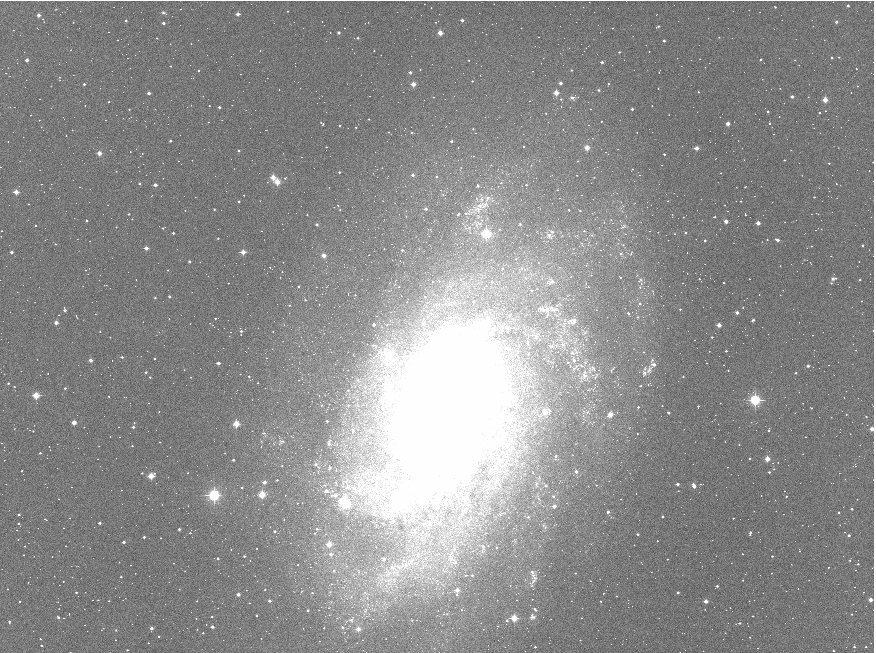
First light with the new camera, November 2025 by G. Bergond:
|
M33 300s |
Horse Nebula 100s |
NGC188 200s |


Contact:


